In 1936 a small group of officers of the Spanish army in what was than Spanish Morocco, in North Africa, rose against the young Spanish Republic. What everybody thought might be another “coup” of the many that have plagued the history of Spain (the last one took place in 1981) became what was to be known as the Spanish Civil War. What everybody thought could last a few days or a few weeks was prolonged for almost three years and left Spain in ruin. Hundreds upon hundreds of books treating the Spanish Civil War, in all its possible facets, both fiction and nonfiction have been published in many countries and in many languages. Songs, plays and movies have also made their mark. Hundreds of theses have been written by history students in the United States attempting to explore and determine the cause or causes of the Civil War. It suffices to say for our purposes that a conservative minority backed by the army and the church, all entrenched in a semi-feudalistic society, fearful of losing their privileges, attempted (and ultimately managed) to destroy a set of social reforms brought about by the Republic (such as divorce, separation of state and church, agrarian and educational reform, etc.) that simply were ahead of their time. On the other side of the spectrum, a large disenfranchised majority, crushed by the depression, saw in the military insurrection an attempt on the part of the rebels to deprive them of their gains.
It was a strange war. It started as a fratricidal fight. But soon foreign elements projected themselves onto the arena, converting the war into an international conflagration. On the one hand the Axis Powers, Nazi Germany and Fascist Italy took the side of Franco who soon became the leader of the rebels or, Nationalists, as they came to be known. The western democracies, the Soviet Union and indeed most of the then free world, became the friends of the Republic; however, while the German and Italian help was so effective, as to be essential to the ultimate Franco victory, the help from democracies became a trickle and soon disappeared.
it was a cruel war. In the rearguard thousands were assassinated mercilessly on both sides without trial and without compassion just for happening to disagree over their political beliefs. Sometimes for something as futile as for wearing a mustache or a hat in the “loyalist” zone (as it use to be known in the United States and in England) or as innocuous as being a Mason in the Franco zone). And yet in the lulls of the fighting, in the many long months of a war of attrition the contending forces took time to fraternize and entertain one another recognizing after all that they were brothers (sometimes in the literal sense of the word) fighting against each other.
it was largely a war of men, not of machines. Science in its many ¡manifestations did not have the decisive role that it would play later on in WWII. It was still man against man with the possibility of displaying chivalry and observing the military code of honor.
But above all (and this is what impels me to reminisce) it was fully and totally a war of ideals. Perhaps the other only conflagration that could be compared with the Spanish war was WWII. It is not by accident that both were the fruit of the clash of ideals that brought about the emergence of two opposing systems of government: democracy and totalitarianism of both the left and right. Another famous civil war that comes to mind, the American civil war, was also a war of ideals but unfortunately it was tainted by the commercial Jealousy between the North and the South. WWI broke out due, to a large degree, to the intense fear on the part of Britain of seeing her hitherto unchallenged command of the seas ruined by the tremendous appetite of imperial Germany for colonies and new markets.
The Spanish war was not a colonial war as were earlier wars fought by the Spaniards against the Moors of Northern Africa in the latter part of the nineteenth century and in the first quarter of the present one. Colonial too was the Spanish—American war. Spaniards went to war in Africa and Cuba in the 19th century and again in Africa in the twenties, just as Americans went to Vietnam in the sixties, without knowing what they were fighting for. But the Spaniards of the 1936-39 war did know, on both sides, what they re fighting for. So well did they know that soon thousands of young people from all over the world joined the ranks of the Republic army and took their side against the Franco forces. It is true that not all who went to Spain to fight were pure idealists. Some were adventurers, looking for excitement. Others were hardened communists obeying the command of the party line, and others, jobless victims of the depression, went to fight simply because they were attracted by the high wages paid by the Republic. But many, many others particularly from England and the United States, were fascinated by the idea of fighting against the dark powers of obscurantism, repression and tyranny, Many of these young people were college graduates or still in college. Some were college teachers. Some professed to be communists. But communism was in vogue among Anglo—Americans intellectuals at the time. They were nonprofessional communists, very different from the card-carrying type. Many of them, when they saw communism in action, abandoned their beliefs. One of them, Eric Blair, better known as George Orwell, persisted in his faith after leaving Spain (“Homage to Catalonia”) but when ultimately saw the light wrote “Animal Farm” perhaps the best satire ever written against communism.
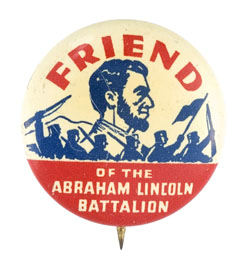
Ideals was what impelled those young men to enlist with the “Lincoln Brigade” and the “British battalion” and to die by the thousands. Such tremendous generosity has not been seen since. Neither the Korean “police operation” nor the Vietnamese conflict, nor the internecine fights in Africa (Nigeria, Ethiopia etc.) nor the clashes between Arabs and Jews have provoked the immediate appeal to human conscience nor the enthusiastic and total support that the Spanish civil war found in the hearts of so many young people.
Back in 1986 a small group of old veterans of the famous “Lincoln Brigade” met in Madrid for old time’s sake. They unanimously agreed that, were they to be transported back to 1936 again, they would act the way they did. As a witness of those terrible, terrible and heroic times I rejoice in paying tribute to those idealist, who sacrificed so much for a cause that appears to be the last of its kind.
 Eugenio Cazorla's Blog